
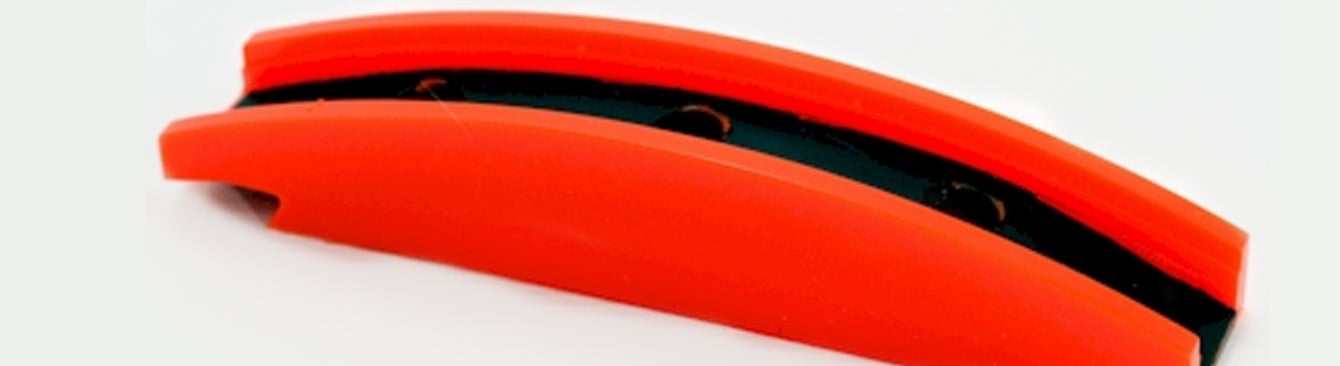
MPC’s R&D is continually improving and expanding cast urethane’s many attributes.
Castable polyurethanes consist of a polyol (backbone) which has been reacted with a diisocyanate to form what is chemically known as a urethane prepolymer. The polyols are typically polyether or polyester and the diisocyanates are typically toluene or methylene. This prepolymer is later reacted with the appropriate curatives to form a solid elastomer. If reacted with a blowing agent, then a microcellular elastomer is formed.
Two reasons: performance and price. On the performance side, you can count on polyurethane to deliver high load bearing capacities, hardness, and abrasion-resistance, as well as elasticity, high-impact resistance, translucence, and resistance to oil, chemicals, ozone, and radiation. Components fabricated from castable polyurethane also enjoy longer service life and that’s where price enters the equation. Longer part life means fewer replacements, reduced labor costs, and less equipment downtime.
These are polyurethanes that are custom formulated and fabricated to eliminate electrostatic discharge (ESD) in machines. MPC has pioneered semi-conductive formulations that are used in developer and charge rollers; thermal print/high-temperature and linerless label rollers; self-cleaning foam and wear-resistant transport rollers; as well as conductive ESD rollers. For more information on conductive polyurethanes.
Conductive polyurethane actually eliminates the need for conductive brushes. It’s especially useful in paper handler rollers to decrease dust and paper jams. Check out the business machine section of this website to learn more about MPC’s ESD and tribocharge management applications.
In general, polyurethanes do not respond well to high temperatures, moist hot environments, and certain acids and solvents. More specifically, urethanes are not useful under heavy service loads at temperatures above 225°F. Furthermore, urethanes cannot withstand prolonged contact with live steam. And, finally, there are certain chemical environments that are unsuitable for polyurethanes, like very strong acids and bases, as well as certain solvents. Aromatic solvents in particular pose a problem, specifically toluene, ketoses (like mek and acetone), and ester (ethyl acetate). However, there are many solvents that are suitable for use with urethanes. If you’re curious about urethane’s ability to resist a particular chemical environment, ask the expert.
Most of the diisocyanate prepolymers or quasi-prepolymers we use, including MDI, TDI, PPDI, TODI, NDI, and HDI, are acquired from Fortune 500 suppliers. These prepolymers or quasi prepolymers are used in combination with MPC’s patented and proprietary curative mixtures of polyols, extenders, and cross linkers, with/without conductive additives, to meet specifications and achieve optimal performance.
The isocyanate concentration (NCO) in prepolymers used in compounding is measured several times a day. The ratios for prepolymer (Part A) and curative (Part B) are computer-controlled on a metering machine for flow rate, temperature, and de-molding time to ensure the accurate stoichiometry during production. This results in urethane parts that possess consistent physical and mechanical properties.
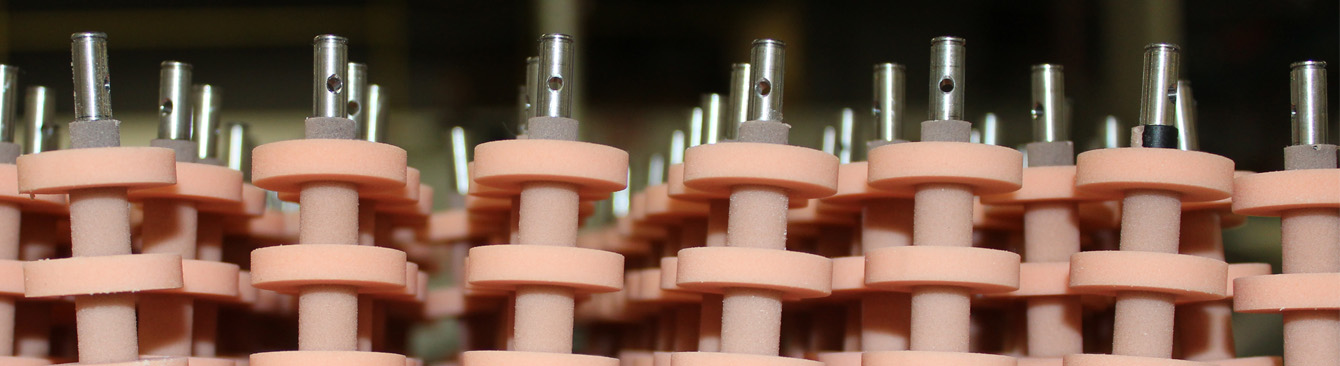
Casting products include solid and foam (open /close cell) in semi-conductive or insulating urethanes required by different industrial applications. The hardness of the solid roller, rod, wheels, sheets and pads can be 5A-80D, while the foam can be 20”OO” to 60A.
Open and closed casting are low cost compounding methods that provide good conformation of the liquid urethane precursors inside the mold before curing. In some special applications and with specially shaped parts, the compression molding, B-stage, and transfer molding processes are also used in manufacturing compounding.